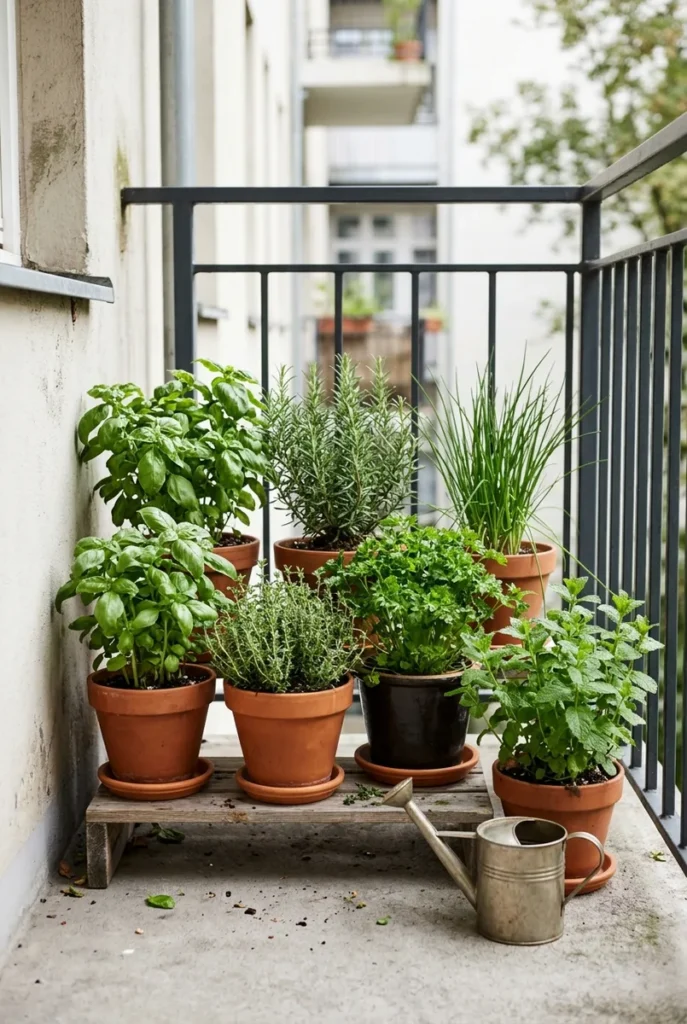
Yes, you can grow most kitchen herbs on a balcony if the spot gets enough direct sun, the pots have drainage holes, and you fill them with potting mix. Count your hours of direct sun first, then pick herbs that match. Six hours or more grows almost anything; 4 to 6 hours suits parsley, chives, mint, and cilantro; under 2 hours is too dark for any herb.
Key points
- A balcony herb garden works when you match herbs to your hours of direct sun, use pots with drainage holes, and fill them with potting mix.
- With 6 or more hours of sun you can grow basil, rosemary, thyme, oregano, and sage.
- With 4 to 6 hours, stick to parsley, chives, mint, and cilantro.
- Keep mint and rosemary in their own pots, and before frost bring rosemary and other tender herbs indoors.
Related guides
Step 1: Count your balcony sun
Check the balcony in the morning, at midday, and in the afternoon on a clear day, and note when direct sun (not just bright sky) hits the spot where pots will sit. Walls, the balcony above, and neighboring buildings all cut sun hours.
UNH Extension says container herbs perform well with at least six hours of direct sun. Iowa State University Extension calls 4 to 6 hours light shade and 2 to 4 hours moderate shade, and says no herb is productive with less than 2 hours. In less light, herbs grow slower and their flavor can be milder.
Easy herbs to grow on a balcony, by sun
| Direct sun on your balcony | Herbs to try | Notes |
|---|---|---|
| 6 hours or more (south or west facing, open) | Basil, rosemary, thyme, oregano, sage, plus everything in the rows below | Rosemary, thyme, oregano, and sage like the mix on the dry side |
| 4 to 6 hours | Parsley, chives, mint, cilantro, chervil, tarragon, sage, basil | Iowa State lists all of these for light shade; growth is slower |
| 2 to 4 hours | Mint | The only herb Iowa State lists for moderate shade |
| Under 2 hours | None outdoors | Grow herbs inside under a light instead |
If your balcony is dim, our guide to low light herbs to grow indoors covers which ones cope with less sun and when a plant light makes sense.
Pots and potting mix for balcony herbs
UNH Extension lists three jobs for an herb pot: enough room for the roots all season, enough weight or width that it does not tip over in the wind, and drainage holes so extra water runs out. Pots that are too small dry out fast and the herbs wilt. Pots that are too large for the plant stay wet and can lead to root rot.
| Herb | Pot size | Share a pot? |
|---|---|---|
| Basil, cilantro, dill | 1 to 2 gallons each | Basil can share with parsley |
| Parsley, oregano, sage | At least 1 gallon, 6 to 9 inches deep | Sage pairs with thyme |
| Chives | At least 1 gallon | Pair with other herbs that like steady moisture |
| Mint | At least 1 gallon | No, always its own pot |
| Rosemary | Its own pot | No, it wants drier mix than most herbs |
Sources: University of Tennessee Extension lists a 1 gallon minimum, 6 to 9 inches deep, for basil, cilantro, parsley, oregano, sage, and mint. University of Georgia Extension says mint spreads and crowds out anything it shares a pot with, sage and thyme both like drier conditions, and chives like more water. UGA also notes basil and dill grow well in 1 or 2 gallon pots. UNH Extension says rosemary prefers drier conditions and does better planted alone.
Use a soilless potting mix, not garden soil. UNH describes these mixes as mainly peat, perlite, vermiculite, bark, or coconut fiber, which hold moisture and still let air reach the roots. Our guide to potting mix vs garden soil explains why. To work out how much mix your planters take, use the GardenDen potting mix calculator.
Balcony rules: wind, weight, and the neighbor below
- Wind. Upper floor balconies are often windy. Wind tips light pots and dries mix faster, so choose wide, stable pots and check soil more often on breezy days.
- Railing planters. Check your lease or building rules before you hang anything over a railing. Some buildings do not allow it.
- Weight. Wet potting mix is heavy. Keep the largest pots near the wall rather than hanging on the railing.
- Drips. Put saucers under pots so water does not run off the edge onto the balcony below, and empty standing water after a heavy watering.
Watering herbs on a balcony
Check the mix with a finger before you water. Small pots in hot sun can need water once a day or more, per University of Tennessee Extension, while the same pots in cool weather may go several days. University of Maryland Extension says bay, marjoram, oregano, sage, and thyme should dry out between waterings. Basil, parsley, chives, and mint like steadier moisture. Grouping herbs by water needs makes this easier.
Balcony herbs in winter
Late fall is when balcony herbs need a decision. Potted plants face harsher winters than the same plants in the ground. Illinois Extension explains that roots are far less cold hardy than the tops, and a pot holds so little mix that the roots get much colder than they would in the ground. Their rule of thumb: a perennial left outside in a pot should be hardy to two zones colder than your zone.
| Herb | What to do in winter | Source |
|---|---|---|
| Rosemary | Bring inside before frost to a cool, sunny window; keep the mix on the dry side | Illinois Extension (not reliably hardy in zone 6 or colder) |
| Bay, lemon verbena | Bring inside before frost | UMD Extension, UNH Extension |
| Oregano, marjoram | Bring inside in cold areas, or protect outside where hardy | UMD Extension |
| Chives, mint, tarragon | Can go indoors after a light frost, or stay out with protection | UMD Extension |
| Thyme, sage | Bring inside, or protect the pot outside if hardy for your zone | UNH Extension, Illinois Extension |
| Basil, cilantro | Annuals; harvest before frost and replant in spring | UNH Extension |
Bringing herbs inside. UMD Extension says to move tender herbs in before a frost and give them a south or west window with at least 5 hours of sun. In winter, most need grow lights for 14 to 16 hours a day to keep producing. Mint, chives, and tarragon benefit from a light frost before you move them in, which brings on a short rest and firm new growth. Our guide to growing herbs indoors year round covers light and care once they are inside, and how to overwinter tender plants covers the move itself.
Leaving hardy herbs outside. University of Maine Extension suggests cutting hardy potted herbs back after the first frost, adding 2 to 3 inches of mulch on top of the pot, and blocking drying winds. Illinois Extension suggests grouping pots together in a spot out of strong wind and sun, such as the north or east side of a building, and mulching them heavily. On a balcony, that usually means clustering pots against the wall. Water the pots before a hard freeze, since moist mix freezes more slowly than dry mix, and check them during winter thaws.
Checklist: starting a balcony herb garden
- Count hours of direct sun on the spot where the pots will sit.
- Pick herbs that match those hours from the table above.
- Use pots with drainage holes, at least 1 gallon for most herbs.
- Give mint and rosemary their own pots.
- Fill with soilless potting mix, not garden soil.
- Check building rules before hanging railing planters.
- Put saucers under every pot and keep heavy pots near the wall.
- Check the mix with a finger before each watering.
- Before the first frost, decide which herbs come inside and which get winter protection.
For more ideas on fitting pots, shelves, and planters into a small space, see our small space garden design guide.
Frequently Asked Questions
Can I grow herbs on a north facing balcony?
Only if it gets at least a few hours of direct sun. Mint copes with 2 to 4 hours, and parsley, chives, and cilantro need about 4 to 6, per Iowa State University Extension. A balcony with under 2 hours of direct sun is too dark for herbs to be productive.
What herbs grow well together in one balcony planter?
Group herbs with similar water needs. University of Georgia Extension pairs sage and thyme, which both like drier mix, and notes chives like more water. Keep mint and rosemary in their own pots.
Can balcony herbs stay outside in winter?
Hardy perennials such as chives, mint, thyme, and sage often can with protection, but potted roots are less hardy than plants in the ground. Illinois Extension suggests choosing plants hardy to two zones colder than yours. Rosemary, bay, and lemon verbena should come inside in most cold climates.
How often should I water herbs on a balcony?
There is no fixed schedule. Small pots in hot sun can need water daily, while cool weather slows drying. Water when the top of the mix feels dry and let oregano, sage, and thyme dry a little more between waterings.
Do herbs on a balcony need fertilizer?
Lightly. UMD Extension says herbs do best in well drained mix that is not too rich. Many bagged potting mixes already contain some fertilizer, which covers the first weeks after planting.