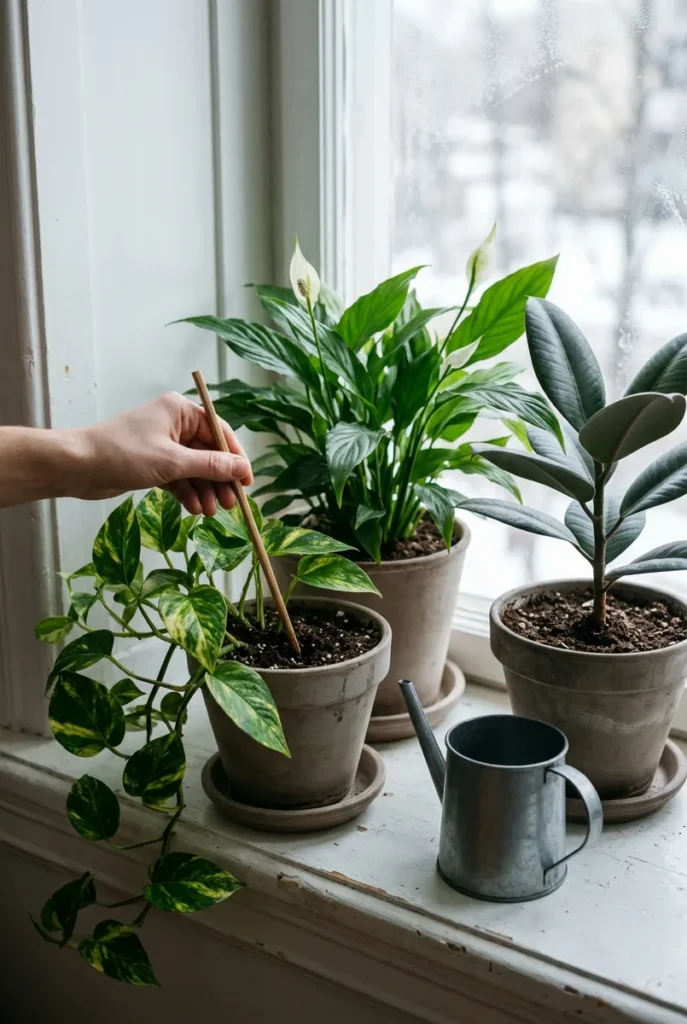
There is no set number of days for watering houseplants in winter. Most need water less often than in summer, so check the potting mix first and water only when it feels dry about 1 to 2 inches down, then water until it drains and empty the saucer.
Key points
- How often to water houseplants in winter depends on the soil, not the calendar.
- Most houseplants need water less often than in summer, so water only when the potting mix feels dry about 1 to 2 inches down.
- When it is dry, water until it drains from the bottom and empty the saucer.
- Overwatering is the most common winter mistake, so if the mix is still damp, wait a few days and check again.
Related guides
Why houseplants need less water in winter
Short, dim winter days slow most houseplants down. UVM Extension calls this resting period quiescence. Growth slows a lot, and some plants such as alocasia and caladium may drop leaves, which is normal. A plant that is barely growing pulls much less water from the pot.
Iowa State University Extension says houseplants need water less often in winter than in spring and summer, and that the right interval depends on the plant species, the potting mix, the temperature, the light, and the humidity. University of Minnesota Extension adds that plants in lower light grow more slowly and use less water.
That is why a summer routine causes trouble now. University of Maryland Extension says overwatering is the number one reason houseplants die in winter, and that many people wrongly assume once a week is the right interval.
What changes how fast a pot dries
Two plants in the same room can need water on very different days. These are the main reasons.
| Factor | Pot dries faster | Pot dries slower | Source |
|---|---|---|---|
| Light | Bright window, active growth | Dim room or north window, slow growth | University of Minnesota Extension |
| Pot material | Unglazed clay, which loses water through the sides | Plastic or glazed pots, which dry from the top down | University of Illinois Extension, University of Maryland Extension |
| Room conditions | Warm room with dry heated air | Cool room or a humid spot | Iowa State University Extension |
| Potting mix | Coarse, fast draining mix | Dense mix that holds water | Iowa State University Extension |
| Plant type | Thirstier plants, such as peace lily, which University of Maryland Extension says needs more water than most | Succulents and cacti | Iowa State University Extension, UVM Extension |
How to check if a houseplant needs water
Check each pot before you water it. Any of these methods works, and using two together is even better.
- Finger test. Push a finger into the mix. Iowa State University Extension says to water when the soil feels dry about one inch down. University of Illinois Extension suggests checking to a depth of two inches.
- Chopstick test. UVM Extension suggests pushing a plain wooden chopstick into the mix. If soil sticks to it, the mix is still moist. If it comes out clean, it is time to water.
- Lift the pot. University of Maryland Extension suggests lifting a pot right after a full watering to learn how heavy it feels, then lifting it again over the next week. A light pot is a dry pot.
- Stick for big pots. For a large planter, slide a stick or ruler down to the bottom and pull it out to see where the moisture still is, as University of Maryland Extension describes.
- Look at the edges. Soil that has shrunk away from the side of the pot has dried at the top.
A moisture meter can help too, though University of Illinois Extension notes that meters are not always reliable. Treat a meter reading as a second opinion, not the final word.
How much to water when it is time
When the soil says yes, water fully. Iowa State University Extension says to keep watering until water flows out of the bottom of the pot, then discard the excess. Do not let the pot sit in a full saucer, since University of Illinois Extension warns against leaving pots standing in water.
- Use room temperature water, not cold water straight from the tap (University of Illinois Extension).
- Avoid softened water, per University of Illinois Extension.
- Bottom watering also works. Set the pot in a few inches of water until moisture wicks up to the surface, then take it out and let it drain.
For most plants in winter, University of Maryland Extension suggests letting most of the soil dry to the feel of a wrung out dish towel. That means barely damp, not bone dry. If a plant does dry out so far that the soil pulls away from the pot, set the pot halfway into a sink or bucket of warm water for an hour or two so the mix can soak water back up.
Signs you are watering too much or too little
Leaves alone can mislead you. University of Illinois Extension points out that wilting can mean the plant is dry, but it can also be a sign of overwatering, because damaged roots cannot take up water. Always check the soil before you act on a droopy plant.
| What you see | Soil is wet | Soil is dry |
|---|---|---|
| Wilting or drooping | Likely too much water. Stop watering and check the roots for rot. | Likely thirsty. Water thoroughly and let it drain. |
| Soft yellow lower leaves | A common overwatering sign. Let the pot dry further before watering. | Check light and recent watering history before changing anything. |
| Small dark flies around the soil | Fungus gnats, which UVM Extension says are common in winter and get worse with overwatering. | Less likely. Look for another source in the room. |
| Crispy brown leaf edges | Check the roots. Soggy soil can damage them so they stop taking up water. | Dry air from indoor heat, which UNH Extension links to dry, brittle leaf edges, or soil left dry too long. |
| Soil pulling away from the pot | Not applicable. | The mix has dried out. Soak the pot as described above. |
If you see mushy stems, a sour smell, or brown roots that fall apart, read our guides on signs of overwatering and root rot prevention and treatment. If small flies are the problem, common houseplant pests shows how to tell fungus gnats from other insects.
Succulents and cacti in winter
Succulents and cacti need even less water in winter than leafy tropical plants. UVM Extension notes that some cacti and succulents go into a deeper dormancy in response to short winter days. Let their mix dry out completely and check again before you water, rather than following a set number of days. Snake plant belongs in this group too. University of Maryland Extension says it handles long dry spells but will not tolerate overwatering.
Humidity, heat, and drafts
Indoor heat dries the air, and that dry air is a separate problem from soil moisture. Watering more does not fix low humidity, and it can rot the roots of a plant that is barely growing.
- UNH Extension says most houseplants prefer 40 to 60 percent relative humidity, while tropical species like it higher.
- UVM Extension suggests grouping plants together, running a humidifier, or setting pots on pebble trays.
- Keep plants away from heat vents, radiators, wood stoves, and drafty windows or doors.
Crispy tips on an otherwise healthy plant often point to dry air. Our guide to brown leaf tips on houseplants walks through the other causes.
Checklist: before you water a houseplant in winter
- Check the mix 1 to 2 inches down, or use a chopstick or the weight of the pot.
- If it is still damp, wait a few days and check again.
- When it is dry, water until it runs out of the drainage holes.
- Empty the saucer once the pot stops dripping.
- Use room temperature water.
- Check wet soil before blaming droopy or yellow leaves on thirst.
- Move plants away from vents and cold glass.
- Give succulents, cacti, and snake plants longer dry spells than leafy plants.
If a plant stays soggy for weeks because its mix is too dense, repot it in spring into a fresh, fast draining mix. The potting mix calculator works out how much mix you need for the pot size. New to indoor plants? Start with our houseplant care guide for beginners.
Frequently Asked Questions
How often should you water houseplants in winter?
There is no fixed schedule. Water when the potting mix is dry about 1 to 2 inches down. A plant in a warm, bright room will reach that point sooner than the same plant in a cool, dim room, so check each pot on its own.
Is watering once a week in winter too much?
For many plants, yes. University of Maryland Extension says many people wrongly assume once a week is the right interval, and overwatering is the top cause of winter houseplant deaths. Check the soil each week instead of watering by habit.
Should I water houseplants less when the heat is on?
Check more often, but do not water by the calendar. Heated air can dry the top of the mix and the leaves faster, while the roots still use little water because growth is slow. Feel below the surface before adding water.
Can I use cold tap water on houseplants in winter?
Use room temperature water. University of Illinois Extension advises against cold water. Filling a watering can and letting it sit indoors for a few hours is an easy fix.
Do houseplants need more humidity in winter?
Many do. UNH Extension says most houseplants prefer 40 to 60 percent relative humidity, and heated indoor air often falls below that. Group plants, use a humidifier or pebble tray, and keep pots away from vents instead of adding more water to the soil.