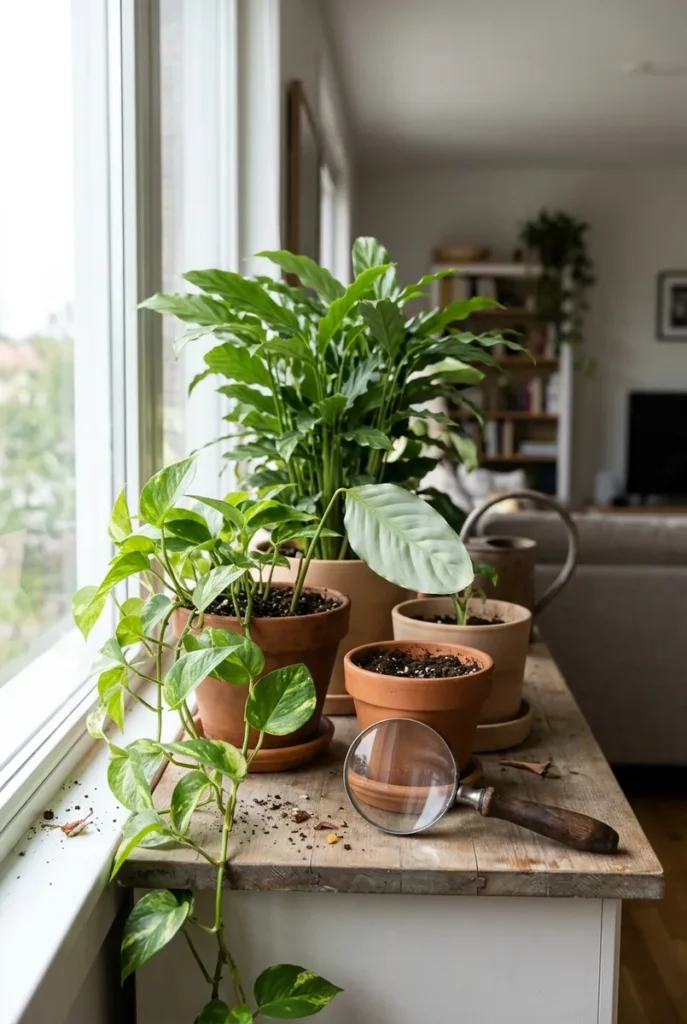
Common houseplant pests include fungus gnats, spider mites, mealybugs, scale, thrips, aphids, and whiteflies. If you spot an unfamiliar insect or fresh damage, isolate the potted plant, then inspect its leaves, stems, soil, pot, and nearby plants before choosing a response.
Key points
- Common houseplant pests include fungus gnats, spider mites, mealybugs, scale, thrips, aphids, and whiteflies.
- Check the soil, leaf undersides, and stem joints to tell them apart, then isolate the plant.
- Fungus gnats hover over damp potting mix, while mites, mealybugs, scale, thrips, aphids, and whiteflies show up on leaves and stems.
- Start with a close inspection, a rinse or wipe, and sticky traps before you reach for a spray.
Related guides
Start with where you see the pest and the damage
Start with the pest’s location and the pattern of damage, not with a single yellow leaf. University of Minnesota Extension recommends checking the tops and undersides of leaves, stems, and containers for insects, webbing, holes, eggs, and discolored leaves. A ten-power hand lens can help, because some of these pests are very small.
Look at new growth and stem joints too, then check pot rims, drainage holes, saucers, and nearby plants.
| Where the sign appears | What it looks like | Likely pest | Common look alike |
|---|---|---|---|
| Soil surface or potting mix | Small dark flies moving near the soil; pale larvae may be in the mix | Fungus gnats | Fruit flies or other small flying insects |
| Leaf surfaces, often undersides | Fine pale stippling, faded leaves, and sometimes delicate webbing | Spider mites | General leaf stress or thrips damage |
| Leaf undersides and leaf axils | White, cottony clusters | Mealybugs | Other white marks, including mildew |
| Leaves and stems | Small, raised bumps that stay attached | Scale | Mealybug wax or unrelated marks on the plant |
| Leaves, tender growth, or developing flowers | Silvery or irregular scars, sometimes with tiny dark spots | Thrips | Spider mite stippling or other pale marks |
| New growth and leaf undersides | Clusters of small, soft-bodied insects | Aphids | Other small insects gathered on leaves |
| Leaf undersides | Tiny white adults flutter up when the plant is disturbed; pale immature stages stay on leaves | Whiteflies | Other small flying insects near the plant |
Yellowing, spots, and leaf drop are clues, not proof of pests. Look for live insects, webbing, honeydew, or fresh feeding marks before settling on an identification. Honeydew is a shiny, sticky substance made by aphids, mealybugs, and scale insects, and it may collect on leaves or on the tabletop below a plant, according to University of Minnesota Extension.
White marks can also have causes other than insects. If you see pale spots without a pest or clear feeding damage, compare them with other causes of white marks on plant leaves.
Fungus gnats: tiny flies around damp potting mix
Fungus gnats are small, dark flies that move around the soil surface or fly close to a pot. University of California ANR describes the adults as delicate and about 1/8 inch long. They are weak flyers, they are attracted to light, and in heavy infestations they often collect on nearby windows. The adults do not feed on houseplants.
The whitish larvae have shiny black heads and can grow as large as 1/4 inch. They generally feed on decaying organic matter or fungi in the soil, and some also feed on roots, which is especially damaging to very young plants. Indoors, fungus gnats are most often a problem in potting mix that is rich in organic matter such as peat moss, especially when the plant is overwatered.
| Clue | What to check | Common confusion | Useful distinction |
|---|---|---|---|
| Small dark flies near a pot | Soil surface, drainage holes, and nearby windows | Fruit flies | Fungus gnats tend to move near potting mix. Check whether flies appear from the soil and whether pale larvae are present in it. |
| Pale larvae in potting mix | Soil, especially when it stays wet | Leaf-feeding pests | Fungus gnat larvae live in the potting media, while leaf pests leave signs on foliage. |
To tell fungus gnats from fruit flies, look for the source rather than relying on one small fly seen in a kitchen. Fungus gnats are often near the soil surface, and larvae in the potting mix are a stronger clue than yellowing or wilting alone.
For a first check, isolate the pot and inspect the soil surface and drainage holes. Overwatering and poor drainage encourage fungus gnats, so compare the soil condition with signs of overwatering in houseplants. Colorado State University Extension says the most important step is to limit watering so the soil surface can dry between waterings. Yellow sticky cards can catch some adults, but those adults may already have laid eggs. For larvae, Colorado State University Extension reports that Bacillus thuringiensis var. israelensis (the H-14 strain) is highly effective as a soil drench. Follow the product label.
Spider mites and thrips: look closely at leaf surfaces
Spider mites are so small that leaf damage is often easier to see than the pests themselves. University of California ANR notes that they cause light-colored speckling on the upper leaf surface and an overall faded look, then bronzed or yellowed leaves. A silky web is often seen with heavier infestations. Mississippi State University Extension says the twospotted spider mite is the most common, and that plants in especially warm locations, such as under a heating vent, and plants that are not being watered enough are especially susceptible.
Check the undersides closely with a hand lens. University of Arkansas Extension suggests shaking or tapping a leaf over white paper and watching for moving specks when mites are hard to spot on the plant.
Thrips are tiny, slender insects that feed on leaf undersides and tender new growth. Mississippi State University Extension describes thrips on houseplants as one-eighth of an inch long or less, with elongate, spindle-shaped bodies. Their feeding can distort new growth and cause leaves to curl downward. Colorado State University Extension says they are usually less than 1/16 inch when full-grown, and that feeding can leave light, irregular silvery areas with tiny dark spots of excrement. Damage in buds or developing flowers may distort and scar petals.
Spider mite stippling can look like general leaf stress, while thrips scars can resemble other pale marks. Colorado State University Extension notes that thrips wounds tend to be larger and more silvery than spider mite damage, so look for the pest or its distinctive signs before deciding what you are seeing.
Isolate the plant and examine both leaf surfaces. For small plants, Mississippi State University Extension says washing mites off with a forceful spray of water can help when you repeat it several times at 3- to 5-day intervals. Focus on the undersides, where mites feed. Foliar sprays of horticultural oil, neem oil, or insecticidal soap can be effective for spider mites if you cover the undersides and treat two to three times at 5-day intervals; check the oil label before applying at close intervals. Systemic imidacloprid treatments do not control spider mites.
After rinsing mites, check undersides and new growth for live pests and fresh stippling. Webbing can remain after mites are gone, so look for movement too. For thrips, remove badly scarred flowers or leaves if the plant can spare them, and inspect tender growth and buds for slender insects or dark specks. Sticky traps, especially yellow or pale blue ones, can help you monitor flying adults, but they do not reach immature thrips feeding on leaves. If you use insecticidal soap or horticultural oil, choose a product labeled for indoor plants and follow its directions.
Mealybugs and scale: check stems, joints, and leaf undersides
Mealybugs look like soft, cottony white clusters, often tucked into leaf axils, stem joints, and the undersides of leaves. University of California ANR describes them as small, pale, sluggish insects about 1/8 to 1/4 inch long. Adult females cover themselves and their eggs with white, waxy material, and they also produce honeydew.
Scale looks different: small, firm bumps stay attached to stems or leaves. University of Maryland Extension describes brown soft scale and hemispherical scale as raised black or brown bumps on leaves and stems. That fixed, shell-like appearance helps distinguish scale from loose residue or cottony mealybugs.
| Pest | Appearance | Where it gathers | Common look alike | First inspection or removal step |
|---|---|---|---|---|
| Mealybugs | White, cottony covering around small insects | Leaf undersides, leaf axils, and stem joints | Loose white residue or other white marks | Isolate the plant and inspect nearby joints. University of Minnesota Extension says you can remove a small number with tweezers or a cotton swab dipped in alcohol. |
| Scale | Firm, raised bumps attached to leaves or stems | Leaves and stems | Mealybug wax or loose marks | Check surrounding stems and leaves. University of Minnesota Extension says a small number can be scraped off with a fingernail file or similar tool. |
Isolate the plant and check other stems and leaves for more bumps or clusters. White marks alone do not confirm a pest. For full removal instructions, see this step-by-step guide to treating mealybugs on indoor plants or the guide to removing scale from plants.
Aphids and whiteflies: check new growth and the underside of leaves
Aphids are small, soft-bodied, pear-shaped insects that often gather on new growth or leaf undersides. University of California ANR says they are about 1/16 to 1/8 inch long, usually green, but sometimes pink, brown, black, or yellow. They can cause yellowing, misshapen leaves, stunted growth, and deformed buds.
Honeydew can accompany aphid feeding, and sooty mold may grow on it. Sticky residue by itself does not identify aphids, because mealybugs and scale also produce honeydew. Look for the insects as well.
Whitefly adults are tiny white insects that fly from the plant when it is disturbed, while immature stages remain on leaf undersides, according to University of Maryland Extension. Mississippi State University Extension notes that you will not control whiteflies by treating only the adults. You have to reach the immatures on the undersides of the leaves.
To tell aphids from whiteflies, check whether insects form visible clusters on growing tips or lift off from foliage when it moves. Isolate the plant, inspect new growth and leaf undersides, and check nearby plants. University of Minnesota Extension says yellow or blue sticky traps can help detect flying insects such as whiteflies, fungus gnats, winged aphids, and thrips, but use them as a monitoring aid, not a substitute for checking the plant. Rinse aphids from tender growth and leaf undersides. For whiteflies, rinse the undersides and remove badly infested leaves if the plant can spare them.
Indoor Pest Inspection Checklist
Use this routine when you see damage or a small insect indoors. University of Minnesota Extension recommends isolating newly acquired plants for one to two weeks, and checking for pests when you water, fertilize, or clean plants.
- Isolate the suspect plant. Keep it apart from your other houseplants while you inspect and decide what to do.
- Check the whole plant. Look at leaf tops and undersides, new growth, stems, and joints for insects, webbing, eggs, holes, honeydew, or fresh damage.
- Inspect the pot and soil. Check the soil surface, pot rim, edges, crevices, drainage holes, saucer, and the bottom of the pot.
- Look over nearby plants and tools. Check other foliage for matching signs before returning the plant to its usual place.
- Repeat the inspection. University of California ANR suggests checking about once a week, especially the undersides of leaves. Note whether you find live pests or fresh damage, rather than judging progress only by whether flying adults are still visible.
| First step | What it can help with | What it does not control by itself |
|---|---|---|
| Wash leaves with a damp paper towel, or rinse the plant in a sink or shower. | Physically removes some pests from plant surfaces. | Does not confirm the pest’s identity or address pests hidden in the soil. |
| Remove mealybugs with tweezers or a cotton swab dipped in alcohol. | Removes individual mealybugs you can reach. | Does not inspect or remove hidden insects elsewhere on the plant. |
| Scrape off a small number of scale insects with a fingernail file or similar tool. | Physically removes accessible scale bumps. | Does not check other leaves and stems for more scale. |
| Let the soil surface dry between waterings and keep dead leaves, stems, and flowers off it. A Bti (H-14) soil drench can target fungus gnat larvae. | Helps address conditions and larvae that encourage fungus gnats. | Does not remove pests feeding on foliage. Sticky traps alone will not end a gnat problem. |
| Use yellow or blue sticky traps to monitor flying insects. | Helps detect flying whiteflies, fungus gnats, winged aphids, and thrips. | Does not eliminate younger stages on plants or in soil. |
Judge progress by whether live pests and fresh damage decline, especially on new growth, not by the disappearance of old scars, webbing, or honeydew alone. Reinspect the same leaf undersides, joints, and potting mix after treatment, since eggs or hidden stages can remain and traps only sample flying adults. If live pests or new feeding marks continue, confirm the identification and check that treatment reached the pest’s location. Follow product directions for repeat applications.
Use new, sterile potting mix when potting indoor plants, not garden soil, and keep the soil surface clear of dead plant material. Fungus gnats and springtails may move when you water, so movement is a cue to inspect the pot, not a diagnosis by itself.
Before a new plant joins your collection, inspect leaf undersides, new growth, stem joints, and the soil surface. Keep it apart from established plants for one to two weeks while you check for live insects or fresh damage. If you confirm pests, maintain separation during treatment and until repeated checks show no live pests or new feeding marks. Clean tools between plants, and do not move infested cuttings or used potting mix between pots.
For outdoor garden pests such as caterpillars, beetles, and borers, use the broader plant pest identification and treatment guide. It covers a different setting from the indoor pest clues in this article.
Frequently Asked Questions
How do I tell fungus gnats from fruit flies?
Look at where the flies are coming from. Fungus gnats usually run across or fly near the soil surface of a houseplant pot, and pale larvae with black heads in the potting mix are a stronger clue than a single fly in the kitchen. Fruit flies are more often around ripening fruit or food scraps, not the potting mix.
Can houseplant pests spread to other plants in the same room?
Yes. Many of these pests can move or be carried to nearby plants, so keep the affected plant separate while you inspect the rest of the collection.
How often should I check houseplants for pests?
Inspect plants when you water, fertilize, or clean them, and take a closer look about once a week, especially on the undersides of leaves. University of Minnesota Extension also recommends isolating a new plant for one to two weeks before it joins the others.
Can houseplant pests harm people or pets?
This guide focuses on damage to plants. Avoid handling pests directly, wash your hands after inspecting an infested plant, and follow the label on any product you use indoors.
Should I throw away a plant with houseplant pests?
Not every plant with pests needs to be discarded. University of Maryland Extension says severely damaged plants should be discarded. Weigh how much live growth is left, whether you can inspect and treat the remaining foliage, stems, and soil, and whether nearby plants are at risk.
Can I reuse potting mix from a plant that had pests?
Use new, sterile potting mix when you pot indoor plants. University of Minnesota Extension advises against using garden soil, and used mix from an infested pot can carry larvae, eggs, or other hidden stages into the next plant.