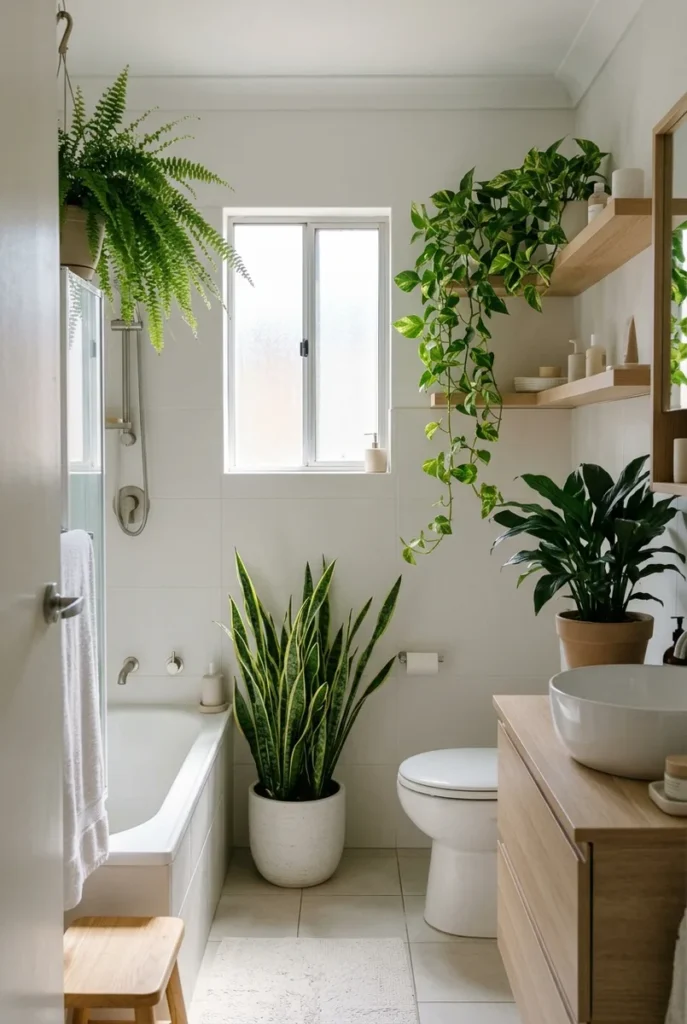
The best low light bathroom plants are tough foliage plants such as snake plant, pothos, heartleaf philodendron, peace lily, Chinese evergreen, cast iron plant, and parlor palm. They handle dim, humid rooms, but no plant lives long in a bathroom that stays dark most of the day, so a room with no window needs a light on a timer.
Key points
- Low light bathroom plants that handle dim, humid rooms include snake plant, pothos, heartleaf philodendron, peace lily, Chinese evergreen, cast iron plant, and parlor palm.
- No plant lasts long in a room that is dark most of the day.
- A bathroom with no window needs a plant light on a timer for about 12 to 14 hours a day, or a plant you rotate to a brighter room.
- For homes with cats or dogs, cast iron plant, parlor palm, spider plant, and calathea are on the ASPCA non-toxic list.
Related guides
Check the light in your bathroom first
Bathroom humidity is a bonus. Light is what decides whether a plant lives there. A small frosted window can be enough for a low light plant. A windowless room is not, unless you add light.
A quick test from University of Arkansas Extension: if the spot is bright enough to read a newspaper during the day without turning on a lamp, there is enough light for low light plants. Do the test where the pot will actually sit, not at the window. Mississippi State University Extension notes that light can drop sharply within a few feet of the glass.
Watch the plant after a few weeks. Arkansas Extension says thin, spindly new growth is a sign of too little light.
| Your bathroom | What to do | Good fits |
|---|---|---|
| Bright window | Use the spot closest to the window for ferns and other medium light plants. | Boston fern, plus any plant on the list below |
| Small or frosted window | Put the plant as close to the window as you can. Do the newspaper test at that spot. | Snake plant, pothos, heartleaf philodendron, cast iron plant, parlor palm, Chinese evergreen |
| No window | Add a light on a timer for about 12 to 14 hours a day, or swap the plant to a brighter room for 4 to 8 weeks at a time. | Snake plant, pothos, or heartleaf philodendron under a light |
Low light bathroom plants compared
Light ratings below come from University of Maryland Extension, UF/IFAS Extension and its Duval County office, NC State Extension, and Clemson HGIC. Light tolerance and pet safety are two different questions. Pet safety comes from the ASPCA toxic and non-toxic plants list.
| Plant | Light it handles | Bathroom notes | Cats and dogs (ASPCA) |
|---|---|---|---|
| Snake plant | Low. University of Maryland Extension says it tolerates low light better than any other houseplant. | Handles dry spells and dry air. Does not tolerate overwatering. | Toxic |
| Golden pothos | Low. Keeps growing in very low light, though the yellow variegation fades to green (University of Maryland Extension). | Trailing vine for a shelf or hanging pot. | Toxic |
| Heartleaf philodendron | Prefers bright light but tolerates low light. Growth gets more spindly in dim spots (University of Maryland Extension). | Trailing vine. Pinch the tips to keep it full. | Toxic |
| Peace lily | Low, such as a north window (UF/IFAS Extension). | Needs more water than most houseplants and wilts quickly when dry (University of Maryland Extension). | Toxic |
| Chinese evergreen (aglaonema) | Low to average light (UF/IFAS Extension, University of Maryland Extension). | UF/IFAS Extension lists it among plants that suit humid bathrooms. | Toxic |
| Cast iron plant | Low (UF/IFAS Extension). | Slow, sturdy floor or counter plant. | Non-toxic |
| Parlor palm | Prefers bright indirect light but tolerates low light; a north or east window is ideal (NC State Extension). | Clemson HGIC says it prefers moderate to high humidity but adapts. | Non-toxic |
| Spider plant | Low, such as a north window (UF/IFAS Extension). | Good in a hanging pot. | Non-toxic |
| Calathea and prayer plant | UF/IFAS Extension lists rattlesnake plant, a calathea, as a low light plant. | Patterned leaves for a counter or shelf. | Non-toxic |
| Boston fern | Medium. Does well near a window (UF/IFAS Extension). | Likes humid kitchens and bathrooms (University of Arkansas Extension). Skip it in a dark room. | Non-toxic |
| ZZ plant | Low, such as a north window (UF/IFAS Extension). | Very tolerant of dim corners. | Not in the ASPCA database, so do not count it as pet safe |
For more choices for dim rooms anywhere in your home, see our guide to the best low light houseplants for dim apartment rooms.
Best picks by bathroom spot
- Floor next to the tub or toilet: snake plant, cast iron plant, or a parlor palm. All three stay upright and take up little floor space.
- Shelf or top of a cabinet: golden pothos or heartleaf philodendron, which trail down. Put them where they get the most light the room has.
- Hanging pot near a window: spider plant or Boston fern.
- Vanity counter: a small Chinese evergreen, peace lily, or calathea.
Bathroom plants for homes with cats or dogs
Several of the most popular dim room plants are toxic to pets. ASPCA lists snake plant, golden pothos, heartleaf philodendron, peace lily, and Chinese evergreen as toxic to cats and dogs. If a pet can reach the plant, pick from these non-toxic options on the ASPCA list:
- Cast iron plant
- Parlor palm
- Spider plant
- Calathea, including prayer plant
- Boston fern, if the bathroom has a window
Our guide to low light plants safe for cats and dogs covers more pet friendly options for dim rooms.
How to grow plants in a bathroom with no window
A bathroom ceiling light that is on only while you are in the room does not give a plant enough light. To keep a plant in a windowless bathroom, use one of these setups.
- Add a plant light on a timer. University of Minnesota Extension recommends 12 to 14 hours of light a day for foliage houseplants. Mississippi State University Extension says most plants under artificial light should sit within 1 to 3 feet of the light. A plug in timer keeps the schedule steady.
- Rotate plants. Mississippi State University Extension suggests moving plants from very dim spots into better light for 4 to 8 weeks, then bringing them back. Two plants that trade places work well.
- Choose the toughest plants. Snake plant, pothos, and heartleaf philodendron are the best bets for this kind of setup.
Mississippi State University Extension notes that light below about 50 foot candles will not keep a plant alive for long, which is why a dark room needs one of these fixes.
Humidity and watering in a dim bathroom
UNH Extension says most houseplants prefer 40 to 60 percent relative humidity, while tropical species like 70 to 80 percent. A bathroom used for daily showers is often more humid than the rest of the home, which helps ferns and other tropical plants, as long as they still get the light they need. Keep pots away from heat vents.
Humidity does not mean more water. University of Minnesota Extension says plants in lower light grow more slowly and use less water. In a dim, steamy bathroom the potting mix can stay wet for a long time, so feel the mix before watering instead of watering on a schedule. Peace lily is the exception that wants water more often, and snake plant is the one most likely to rot if kept wet. Our guide on how often to water houseplants in winter explains how to check a pot and what too much water looks like.
What not to put in a dark bathroom
- Succulents and cacti. Most need bright light, and University of Arkansas Extension notes they handle low humidity well, so a dim, steamy bathroom suits them poorly.
- Plants that need bright light. University of Arkansas Extension says high light plants become spindly or stop flowering in low light.
- Boston fern in a windowless room. It likes the humidity but needs medium light.
Checklist: setting up a low light bathroom plant
- Do the newspaper test at the exact spot where the pot will sit.
- Pick a plant rated for low light if the test is borderline.
- Check the ASPCA list if a cat or dog can reach the plant.
- Use a pot with a drainage hole and empty the saucer after watering.
- For a windowless room, set a light on a timer for 12 to 14 hours a day.
- Keep the plant away from heat vents.
- Feel the mix before watering, and expect to water less than in a bright room.
- Watch for thin, stretched new growth, which means it needs more light.
Frequently Asked Questions
Can a plant live in a bathroom with no window?
Only with help. Give it a plant light on a timer for about 12 to 14 hours a day, or rotate it into a brighter room for 4 to 8 weeks at a time. Snake plant, pothos, and heartleaf philodendron cope best with this setup.
What is the best low light plant for a bathroom?
Snake plant is the toughest choice. University of Maryland Extension says it tolerates low light better than any other houseplant. It is toxic to cats and dogs, so cast iron plant or parlor palm are better picks for pet homes.
Which bathroom plants are safe for cats?
Cast iron plant, parlor palm, spider plant, calathea, prayer plant, and Boston fern are on the ASPCA non-toxic list for cats and dogs. ZZ plant is not in the ASPCA database, so do not treat it as safe.
Can I put a plant in the shower?
A spot near the shower can suit humidity loving plants such as ferns and Chinese evergreen, according to UF/IFAS Extension, but only if they get enough light there. Keep plants out of the direct spray of hot water.
Do bathroom plants absorb moisture or stop mold?
Do not count on plants to dry out a bathroom or prevent mold. Choose them for the light you have, and handle mold with ventilation and cleaning.