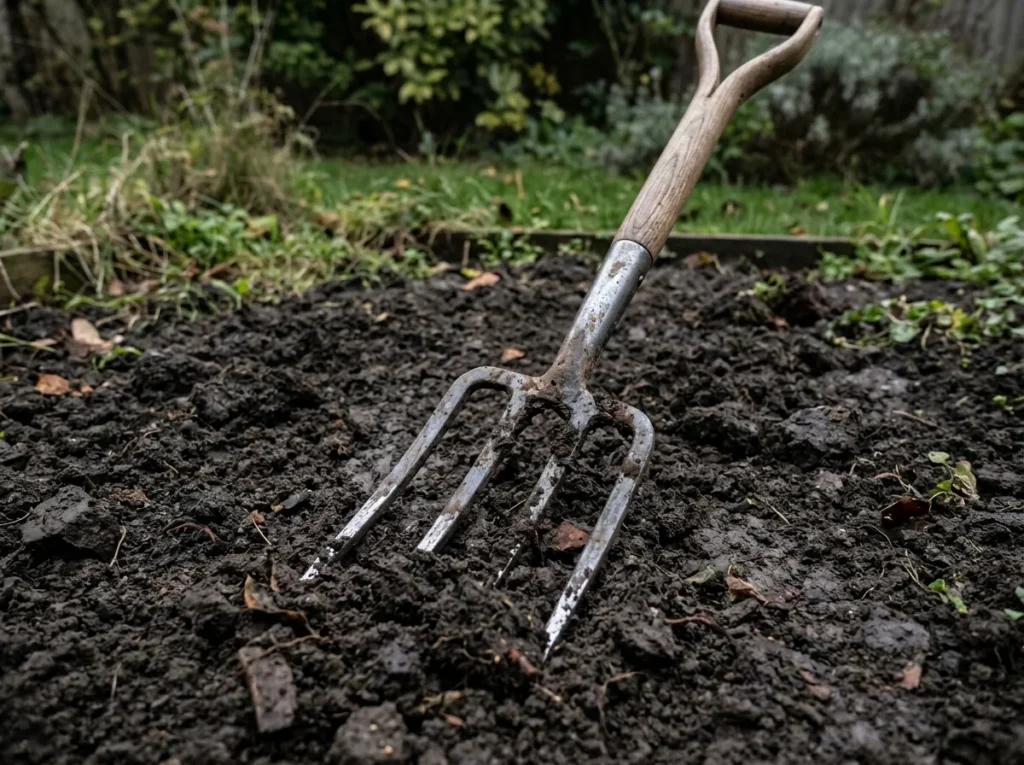
A spading fork, also called a digging fork, is the tool to reach for when a spade starts to bounce off compacted or clay soil. Four flat tines slide in more easily than a solid blade, then break the clod as you lever back. This guide covers four forks you can still find on Amazon, all checked against a live product page, for clay, compacted beds, and stony ground.
Key points
- Spading forks for clay from Bully Tools, Fiskars, and Roamwild.
- Covers tines, handles, and current Amazon listings.
- A fork loosens soil; a spade digs.
As an Amazon Associate, The Garden Den earns from qualifying purchases.
If you are still deciding between a fork and a spade, start with our spading fork vs spade guide. The short version is that a fork loosens and lifts, while a spade cuts and digs a clean hole.
What matters in a spading fork
Look at the tines first. Flat, fairly wide tines are for soil. Thin, rounded, or strongly curved tines belong on a pitchfork, which is built to move loose hay or manure, not to pry clay apart. Four tines is the usual count on a full-size digging fork.
Handle length and grip change how much work your back does. A D-grip or T-grip gives you a place to push and to keep the tool from twisting when a tine hits a stone. Fiberglass and all-steel shafts do not rot if they sit wet. Wood can feel kinder in the hand, but it needs to stay dry in storage.
Weight is a tradeoff. An all-steel fork will take more abuse in rocky ground, and it is heavier to lift all afternoon. A fiberglass shaft trims some of that weight. In clay, wait until the soil is damp enough to mark with a thumb, not wet enough to smear. Dry clay fights every tool. Soaking-wet clay packs on the tines and smears the structure you are trying to keep.
| Fork | Handle | Best use |
|---|---|---|
| Bully Tools D-grip fork | 44 in. fiberglass D-grip | General digging and compost turning |
| Bully Tools all-steel fork | All-steel T-style | Rocky or very hard ground, heavy use |
| Fiskars 1070673 spade fork | About 120 cm, plastic D-grip | Hard, stony soils, per the model listing |
| Roamwild Multi-Digger | Fiberglass, dual soft grips | Gardeners who want a lighter shaft and a padded grip |
Bully Tools Spading Fork with D-Grip, 44″ Fiberglass Handle
Bully Tools Spading Fork with D-Grip, 44″ Fiberglass Handle
Check price on Amazon
This is a straightforward Made-in-USA digging fork: a steel head with four flat tines and a 44-inch fiberglass shaft that ends in a D-grip. The length is in the usual range for standing work in a bed or a compost pile. You step on the back of the head, drive the tines in, and rock the handle to lift and crack the soil.
It is a good default if you want a known brand rather than an unbranded 45-inch listing. We used it in this guide, and as a replacement on our fork vs spade article, after a generic wood-handle fork page on Amazon went down.
Best For: Gardeners who need a full-size fork for clay, compacted beds, and compost, and who prefer a fiberglass D-grip.
Pros:
- Steel digging head with four flat tines, not a hay-style pitchfork.
- 44-inch fiberglass shaft with a D-grip, a common comfortable length for standing work.
- Made in USA, from a brand that also sells shovels we have reviewed separately.
Cons:
- A full-size fork is clumsier than a border fork in tight raised beds.
- Fiberglass is durable, but some people still prefer the feel of a wooden shaft.
Bully Tools All Steel Spading Fork, T-Style Handle, Made in USA
Bully Tools All Steel Spading Fork T-Style Handle, Made in USA
Check price on Amazon
This version drops the fiberglass shaft and uses an all-steel T-style handle. That is the fork to consider if you regularly hit stones, roots, or packed subsoil and have bent a lighter tool before. Steel throughout adds strength and also adds weight, so try to judge whether you will be prying hard or turning beds for an hour at a stretch.
The T-handle gives two-handed control when a tine wedges on a rock. It is a different feel from a D-grip. Neither is universally better; it comes down to how you like to push and lift.
Best For: Heavy or rocky ground, and anyone who has already bent a lighter fork.
Pros:
- All-steel build, made in the USA, aimed at hard use.
- T-style handle helps when you need to twist or pull a stuck tine.
- Same brand as the fiberglass D-grip model, so the digging head follows a similar idea.
Cons:
- Heavier than a fiberglass or wood-shaft fork, which adds fatigue in long sessions.
- Steel handles can be cold and less forgiving if you bump your knuckles.
Fiskars 1070673 Spade Fork for Hard, Stony Soils
Fiskars 1070673 Spade Fork for Hard, Stony Soils, with 4 Prongs, Length 120 cm
Check price on Amazon
Fiskars lists this 1070673 model specifically for hard, stony soils. It has four steel prongs and a plastic handle, with a listed length of 120 cm, which is a little longer than the 44-inch Bully D-grip. The extra length can help if you want more leverage, or if you prefer not to stoop as far.
This is the Fiskars digging fork we could confirm on amazon.com. Older Fiskars fork ASINs we checked no longer resolve, so this is the listing to use for now. As with any imported or region-specific model number, confirm the handle and head match what you expect when you open the product page.
Best For: Stony or compacted ground, and gardeners who want a longer Fiskars shaft.
Pros:
- Sold as a fork for hard, stony soils, which is the job most people buy a spading fork to do.
- Four steel prongs and a 120 cm listed length for leverage.
- Fiskars is a widely available brand if you later need to match other tools in the shed.
Cons:
- The listing uses metric length and a model number that may look unfamiliar if you are used to US-only Fiskars tools.
- A plastic handle is lighter, but it is not the same as a wood or fiberglass shaft if you are picky about feel.
Roamwild Multi-Digger Garden Digging Spading Fork
Roamwild Multi-Digger Garden Digging Spading Fork with Dual Soft AIR Light Grip Technology
Check price on Amazon
Roamwild sells this as a lighter fibreglass spading fork with two soft grips on the shaft. That design is aimed at reducing the harsh feel of a bare handle when you are driving tines into heavy soil. We already mention it in our fork vs spade guide, and the Amazon product page still matches the name.
If hand or wrist comfort is the main reason you have avoided a full-size fork, this is the pick to look at first. It is still a digging fork, not a miracle tool. Clay will be clay. A padded grip just makes the same work a bit easier to hold.
Best For: Gardeners who want a lighter fiberglass fork and a softer grip, including longer sessions in heavy soil.
Pros:
- Fibreglass shaft with dual soft grips, built for comfort as much as for digging.
- Listed as a digging and spading fork, so the tines are meant for soil, not hay.
- A reasonable alternative if a plain steel or wood handle bothers your hands.
Cons:
- A lighter build may not be the first choice if you routinely pry against large stones.
- The extra grip material is one more part that can wear or get grimy and needs a rinse after muddy work.
How to use a spading fork in clay
Work a bit at a time. Drive the tines in as close to vertical as you can, then pull the handle toward you to lift and crack the clod. You do not need to turn every forkful completely over. In a bed you plan to plant soon, loosening and leaving the surface rough is often enough, and it buries fewer weed seeds than deep flipping.
If the tines will not enter, the soil is too dry or you have hit a stone or a root. Move a few inches and try again. A fork is a poor breaking bar. Using it that way is how tines bend. For a planting hole with clean sides, switch to a spade or a shovel such as the Bully Tools 82515.
Frequently asked questions
Is a border fork better in raised beds?
Often yes. A border fork is a shorter, narrower spading fork made for tight beds and paths. The four forks above are full-size tools. If your beds are narrow and already loose, a border fork is easier to maneuver. If the soil is compacted clay, a full-size fork still does the heavy work faster.
Can I use a pitchfork instead?
Not for digging. A pitchfork has thinner tines and will flex or bend in clay. Keep the pitchfork for moving loose mulch, hay, or compost that is already friable, and use a spading fork to break ground.
Do I still need a trowel?
Yes. A fork opens the bed. A hand trowel plants, weeds, and works in tight spots around roots. In clay, a stout trowel matters too. We keep a separate list of trowels for clay and heavy soil.
Bottom line
If you want one fork and a known brand, start with the Bully Tools D-grip. Step up to the all-steel Bully if your ground is rocky or you have bent a lighter fork. The Fiskars 1070673 is the Fiskars model we could still confirm for hard, stony soil. The Roamwild is the comfort-oriented option. None of these will make dry clay easy. Time the work for soil that is just barely moist, and stop when the tines start to bend rather than bite.