Plant fall garlic as the soil cools and before the ground is expected to freeze, and adjust the calendar window for your USDA zone, local frost pattern, and elevation. The goal is to give cloves time to establish roots without leaving them in warm soil long enough to produce vulnerable top growth. Cover each clove with about 2 to 3 inches of soil, spacing cloves 4 to 5 inches apart.
Key Takeaways
- Use zone windows as starting estimates, then refine them using local frost patterns and the expected ground freeze. A USDA hardiness zone describes typical winter minimum temperatures, not the date of the first frost.
- Plant as the soil cools, before the ground is expected to freeze. Cooling soil helps garlic settle in for winter.
- Plant cloves with the basal plate down and the pointed end up. Oregon State University recommends planting cloves about 2 inches deep.
- Space cloves 4 to 5 inches apart, with rows about 12 inches apart for access and airflow.
- Mulch after the ground freezes in cold winter areas. Keep the mulch layer separate from the soil covering the cloves.
- Choose hardneck garlic for colder regions and scapes, or softneck garlic for milder climates and flexible necks that can be braided.
Free Printable Worksheet (PDF)
Print or save the one-page companion to this guide: Fall Garlic Planting Calendar and Depth Reference Sheet. It collects the key tables and the checklist from this article.
Related garden guides
Choose a planting window using zone and local conditions
Garlic timing by zone is a useful first estimate, not a fixed calendar rule. USDA hardiness zones describe average annual extreme winter cold, while frost dates and ground freeze help you decide when to plant; this guide to hardiness zones and frost dates explains how those measures differ.
For fall planting, use the following windows as a starting schedule. Local ground freeze timing takes priority, especially if your garden sits at a different elevation or has a sheltered or exposed microclimate.
| USDA zone | Timing cue | What to check locally |
|---|---|---|
| Zones 3 to 4 | In early fall, as soil cools and before the ground freezes | How soon the ground typically freezes at your site |
| Zones 5 to 6 | As soil cools, before the ground freezes | Soil cooling, forecast trends, and local first frost patterns |
| Zones 7 to 8 | In later fall, as soil cools and before the ground freezes | Whether the bed is sheltered, exposed, or at higher elevation |
| Zones 9 to 10 | In the coolest part of autumn, once soil has cooled; do not wait for a ground freeze | Cooler autumn soil and local seasonal patterns |
These are practical starting estimates, not official USDA planting dates. For a closer bed specific plan, use local frost windows and regional planting conditions, then adjust for slopes, low spots, nearby buildings, and wind exposure.
Planting as the soil cools and before it freezes gives cloves time to establish roots while reducing the time they spend making tender top growth in warm weather. The ground freeze and your local conditions matter more than a single thermometer reading.
Garlic also needs winter cold to form bulbs. University of Nebraska-Lincoln Extension states that dormant cloves and young garlic plants must be exposed to cold temperatures of 32 to 50°F for one to two months to induce bulb formation.
In mild winter areas such as Zone 9b, use cooler autumn soil and local seasonal patterns rather than waiting for a ground freeze that may not arrive. Winter protection there is more about limiting moisture stress and sharp temperature swings than insulating against deeply frozen soil.
Planting too early can encourage shoots before the coldest weather, while planting too late leaves less time for root establishment. A few emerging leaves do not automatically mean the planting has failed, but avoid using a warm spell as a reason to plant far ahead of the usual cooling period.
A practical latest point is while the bed remains workable and autumn soil has cooled, before the ground freezes. If the local window is closing but the soil is still workable, plant promptly rather than waiting for a perfect forecast; late cloves may establish less evenly. Once the ground is frozen, do not force cloves into it. Wait until the soil can be worked again. Spring planting may still produce plants, but bulb formation is less dependable if cloves miss the winter cold garlic needs.
Select hardneck or softneck garlic and sound cloves
Choose hardneck garlic if your winters are cold or you want to harvest scapes, the firm flower stalks that emerge from the plant. Hardneck bulbs typically form fewer, larger cloves than softneck bulbs.
Softneck garlic suits milder climates and has flexible necks that can be braided after harvest. With proper curing and storage, softneck types generally keep longer than hardneck types.
Separate a healthy bulb into individual cloves shortly before planting. Keep the papery skins intact and choose firm, full sized cloves; shriveled, soft, or damaged cloves are less likely to establish well.
Garlic sold as seed garlic is intended for propagation, making it the more dependable choice for a home bed.
Prepare the bed and plant at the right depth
Choose a sunny bed with loose, fertile, well drained soil. Loosen compacted ground and improve drainage before planting because garlic bulbs are prone to problems in waterlogged soil; this vegetable garden guide covers basic site and bed preparation.
Set each clove with its pointed end up and its flat basal plate down. This clove orientation helps shoots grow upward from the pointed tip while roots emerge from the basal plate.
Measure planting depth as the soil covering the top of the clove up to the finished soil surface. Do not measure from the bottom of a furrow, and do not count winter mulch as soil cover.
| Planting measurement | Practical guidance | Extension reference |
|---|---|---|
| Cover cloves to a depth of about 2 to 3 inches | About 2 to 3 inches | University of Nebraska-Lincoln Extension |
| Clove placement and spacing | Basal plate down, 4 to 5 inches apart in rows, and 2 inches deep in prepared beds | Ohio State University Extension |
| Row spacing | Leave room for access and airflow | Working layout recommendation |
The depth recommendations are easy to reconcile when you measure soil above the clove rather than total furrow depth. Nebraska Extension recommends about 2 to 3 inches of soil cover, while Oregon State University recommends about 2 inches.
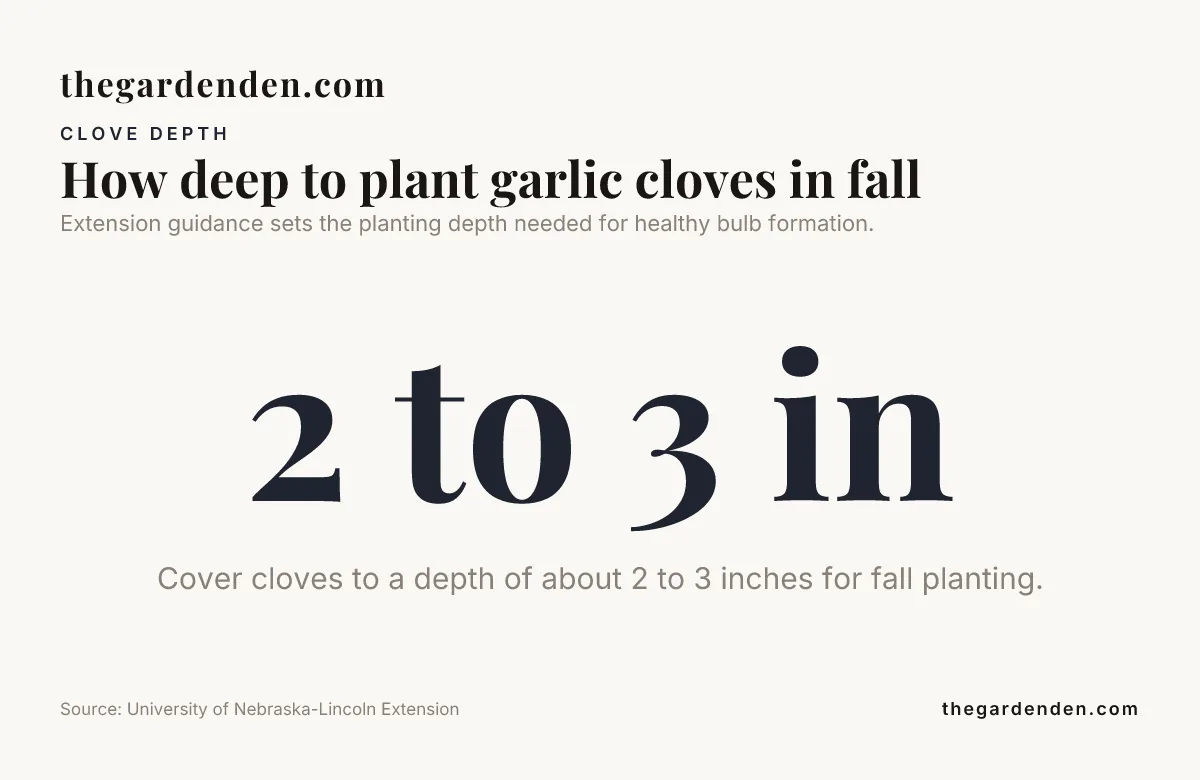
Extension guidance sets the planting depth needed for healthy bulb formation.
Mulch after planting and protect the bed through winter
In cold winter regions, apply clean, weed free mulch after the ground freezes. University of Nebraska-Lincoln Extension recommends a light application of mulch, 1 to 2 inches, after the ground freezes to help prevent frost heaving throughout the winter.
Keep this winter mulch separate from the soil covering the cloves. In places where the ground rarely freezes, use a lighter, breathable cover and adjust it to rainfall and drainage so the bed does not stay soggy.
Avoid hay and other mulch that may carry weed seeds. In spring, pull back excess cover as shoots emerge rather than packing mulch tightly around the new growth.
Spring garlic care and planting Checklist
As shoots emerge, pull back excess mulch and keep the bed evenly moist without leaving it waterlogged. Garlic has shallow roots and competes poorly with weeds, so regular weeding helps the plants use available water and nutrients.
Avoid heavy nitrogen feeding late in the season because it can favor leafy growth over bulb development. Reduce watering as bulbs approach maturity, and keep the soil moisture checks consistent rather than relying on the surface appearance alone; this vegetable garden watering guide explains how to assess moisture and adjust watering to conditions.
When autumn soil is dry, water after planting enough to settle soil around the cloves. Check moisture below the surface before watering again, and avoid frequent shallow watering or leaving the bed saturated.
- ☐ Choose a sunny, well drained bed and a garlic type suited to your climate.
- ☐ Separate firm, full sized cloves shortly before planting.
- ☐ Set each clove basal plate down, using the recommended soil cover and spacing.
- ☐ Water after planting if the soil is dry.
- ☐ Add winter mulch at the appropriate time for your climate.
- ☐ Check moisture, weeds, and shoot growth in spring.
Summary
Fall garlic planting comes down to reading the conditions in your own bed, not following one date for every garden. Use your zone as a starting point, plant into cooling soil ahead of the expected ground freeze, orient cloves correctly, and keep soil cover distinct from winter mulch.
Choose hardneck garlic for cold winters or scapes, and softneck garlic for milder climates and braidable necks. For more practical seasonal guidance, keep exploring The Garden Den.
Frequently Asked Questions
How often should I water garlic in the fall?
There is no fixed weekly schedule because rainfall, soil texture, and bed exposure change how quickly the soil dries. Check several inches below the surface after dry weather, and expect sandy beds or raised beds to dry sooner than heavier soil.
Should I soak garlic cloves before planting?
Soaking is not essential for ordinary planting, so clean, dry cloves can go directly into the bed. Do not soak cloves that are damaged or show signs of rot.
Can I plant garlic from the grocery store?
You can try a small, separate planting and label it so you can compare its growth with your other garlic. Keeping the trial apart makes it easier to judge how evenly it grows and how the bulbs perform at harvest.
How do I know when garlic is ready to harvest?
Yellowing and drying lower leaves while several upper leaves remain green is a useful maturity cue. Lift a test bulb to judge its size and wrapper condition instead of waiting for every leaf to die.
How should I cure garlic after harvesting?
Cure bulbs in a shaded, dry, airy place until the outer skins and necks are dry. Then trim or braid them according to type and store them in a cool, dry, ventilated location.
Download the Companion Printable Sheet (PDF)
Print or save the one-page companion to this guide: Fall Garlic Planting Calendar and Depth Reference Sheet. It collects the key tables and the checklist from this article.
Published by The Garden Den, a publication of Viking Trading Group LLC.