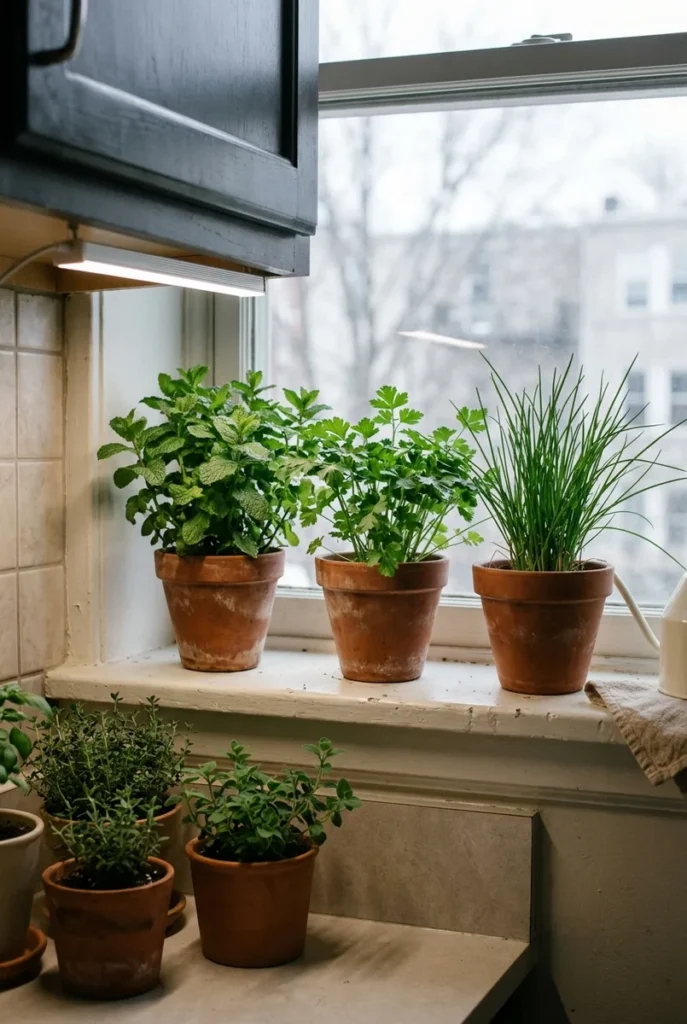
Mint handles low light best of the common kitchen herbs, followed by parsley, chives, lemon balm, chervil, and cilantro. Even these need a few hours of direct sun or a grow light. Iowa State University Extension lists mint as the only herb for spots with 2 to 4 hours of direct sun, and no herbs at all for spots with less than 2 hours.
Key Takeaways
- Start with the better low light bets: mint, parsley, chives, lemon balm, chervil, and cilantro, in that order.
- Low light is not no light. No herb is listed for heavy shade, which is under 2 hours of direct sun, by Iowa State University Extension.
- Expect slower growth and milder flavor. A dim winter window is not a promise of frequent or large harvests.
- Check the light at leaf level. Window direction matters, but so do the distance from the glass and the direct sun that reaches the plant.
- Add a grow light when natural light falls short. Iowa State University Extension recommends full spectrum lighting close to the leaves, with the daily timing controlled by a timer.
- For broader container, light, and harvesting guidance, see our guide to growing herbs indoors year round.
Related guides
Herbs That Tolerate Some Shade
Iowa State University Extension sorts edible plants by how many hours of direct sun they get. Here is its herb list:
| Shade category | Hours of direct sun | Herbs listed by Iowa State University Extension |
|---|---|---|
| Light shade | 4 to 6 | Basil, chervil, chives, cilantro, mint, parsley, sage, and tarragon |
| Moderate shade | 2 to 4 | Mint |
| Heavy shade | Under 2 | No herbs listed |
Light shade still means direct sun reaches the leaves. If your apartment window provides less light than the table describes, growth may be slow and leaves may taste milder, even for herbs that tolerate some shade.
The Garden Den’s guide to houseplants for dimly lit rooms can help if you also want greenery for a spot that is too dark for culinary herbs. Edible herbs need usable light, and a windowless or truly dark location calls for a grow light.
Judge the Light at Your Window
Light is usually the most limiting factor for indoor herbs, according to Iowa State University Extension’s indoor herb guide. Most herbs want about 8 hours of direct light indoors, while some tolerate as little as 6.
Judge the growing spot by watching the sun reach the herb’s leaves, not by how bright the room looks. Consider the window direction, how far the pots sit from the glass, and the shorter days of late fall and winter; do not assume every north-facing window provides the same light.
| Indoor light guidance | What it means for your herbs | Source |
|---|---|---|
| Most herbs want about 8 hours of direct light indoors | Check whether sun reaches the leaves for much of the day. | Iowa State University Extension |
| Some herbs tolerate as little as 6 hours | Shade tolerance can help you choose, but it does not mean a plant will grow quickly in a dim room. | Iowa State University Extension |
| A bright east or west window can work as well as a south window | The window needs to be bright. Direction alone does not describe the light reaching a pot. | Iowa State University Extension |
Put pots right at the glass, where the most light reaches them, and rotate windowsill pots often so every side gets light, as Penn State Extension advises.
Use a Grow Light When the Window Falls Short
When natural light is not enough, use a full spectrum grow light. Iowa State University Extension recommends placing grow lights 6 to 12 inches from the leaves for higher light intensity.
Put the light on a timer for 12 to 16 hours a day, following Iowa State University Extension’s indoor herb guidance. Raise the light as the plants grow so it stays at that distance.
A simple setup is a full spectrum grow light positioned above the pots, close enough to follow the distance guidance, with a timer controlling the daily lighting period. If plants remain thin or produce small leaves, check the distance and whether the light reaches the whole plant before changing other care.
What to Expect from Growth and Flavor
Low light herbs can grow more slowly and have milder flavor, says Iowa State University Extension. Penn State Extension adds that herbs short on light can become thin and spindly, with small leaves and less aroma.
Those signs are useful when you are deciding whether a window is enough. A slow, spindly plant with small leaves is a reason to reassess its light before expecting a larger harvest or adding more fertilizer.
Best bets for a dim window
- Mint: Iowa State University Extension lists mint alone for moderate shade. Clemson Extension and Washington State University Extension also identify mint as a part shade herb.
- Parsley: Iowa State University Extension lists it for light shade, and Clemson Extension and Washington State University Extension identify it as a part shade choice.
- Chives: Penn State Extension names chives among herbs that tolerate lower light, and Iowa State University Extension includes them in light shade.
- Lemon balm: Penn State Extension names it as tolerant of lower light, and Oklahoma State University Extension includes it among herbs that tolerate some shade.
- Chervil: Iowa State University Extension lists it for light shade, and Oklahoma State University Extension includes it among herbs that tolerate some shade.
- Cilantro: Penn State Extension names it among herbs that tolerate lower light, while Iowa State University Extension lists it for light shade.
Keep mint in its own pot because it spreads, and keep its soil moist, as Clemson Extension and Washington State University Extension advise. Penn State Extension lists lemon balm, chives, and cilantro as tolerating lower light with 2 to 6 hours of direct sun.
Herbs to skip without a grow light
For a dim winter window without supplemental light, skip rosemary, thyme, bay, basil, lavender, and dill. Penn State Extension says bay, rosemary, and thyme do best in direct sun, while Oklahoma State University Extension says lavender, dill, sage, thyme, and rosemary need full sun.
Basil appears in Iowa State University Extension’s light shade list, but light shade still means direct sun reaches the plant. In a genuinely dim winter spot, it is a less reliable choice than the six best bets above; use a grow light if basil is part of your indoor herb garden.
| Herb | Least direct sun listed | Source | Tip |
|---|---|---|---|
| Mint | 2 to 4 hours | Iowa State; Clemson and WSU call it a part shade herb | Give it its own pot and keep the soil moist. |
| Parsley | 4 to 6 hours | Iowa State; Clemson and WSU call it a part shade herb | Slow to start from seed, so a nursery plant is quicker. |
| Chives | 2 to 6 hours | Penn State; Iowa State lists 4 to 6 | Snip leaves from the outside of the clump. |
| Lemon balm | 2 to 6 hours | Penn State; Oklahoma State says it tolerates some shade | Spreads like mint, so keep it potted alone. |
| Chervil | 4 to 6 hours | Iowa State; Oklahoma State says it tolerates some shade | Give it a spot with some direct sun, not a dark corner. |
| Cilantro | 2 to 6 hours | Penn State; Iowa State lists 4 to 6 | Expect a short harvest window before it flowers. |
| Basil, sage, tarragon | 4 to 6 hours | Iowa State | Use a grow light in a dim winter room. |
| Rosemary, thyme, bay | Direct sun | Penn State; Oklahoma State says rosemary and thyme need full sun | Skip them without a grow light. |
| Lavender, dill | Full sun | Oklahoma State | Skip them without a grow light. |
The shade categories do not promise quick growth indoors. If you want regular cooking portions, plan for a grow light rather than relying on a north or east window to deliver a large winter harvest.
Basic care when growth is slow
Use a pot with drainage holes and avoid leaving excess water around the roots. In dim conditions, do not respond to slow growth by keeping the mix constantly wet or adding extra fertilizer as a substitute for light.
If the plant looks weak, compare its leaves and stems with the light signs above first. If water may also be an issue, use our guide to signs of overwatering plants as a separate check, rather than assuming every decline has the same cause.
For a few herb pots, use the potting mix calculator to work out how much mix you need. If you bring outdoor herbs inside, inspect them before placing them beside your indoor plants; for healthy stems you want to keep growing, see our guide to propagating plants from cuttings.
Low Light Herb Growing Checklist
- Count the direct sun hours that reach the leaves, then compare them with Iowa State University Extension’s shade categories.
- For a spot with 4 to 6 hours of direct sun, choose among herbs listed for light shade. Mint is the only herb in the moderate shade category, at 2 to 4 hours.
- If natural light is too limited, use the full spectrum grow light setup described above, with the light close to the leaves and controlled by a timer.
- Expect slower growth and milder flavor when herbs receive less light, as Iowa State University Extension notes.
- Rotate windowsill pots often, following Penn State Extension, and check that each plant receives the light you intended.
- Keep expectations modest for winter harvesting; choose supplemental light if you need dependable leaf growth for cooking.
Summary
For a small apartment herb garden, start with mint, parsley, chives, lemon balm, chervil, or cilantro, then judge the actual light at the leaves. Low light herbs to grow indoors still need light, and in a dim room even tolerant herbs grow more slowly with smaller, milder leaves.
Use a grow light when the window falls short, and treat slow or spindly growth as a reason to check light before changing everything else.
Frequently Asked Questions
Can herbs grow in a windowless kitchen if I use a grow light?
Yes, if the grow light supplies the light the herbs would otherwise get from a window. No herb grows well in a truly dark spot, so a kitchen without windows needs supplemental light for herbs.
Is a north facing window enough for indoor herbs?
Window direction alone cannot tell you how much direct sun reaches a particular pot. Check the light at the leaves, and use a grow light if the spot does not provide enough for the herbs you choose.
Which herbs are listed as tolerating moderate shade?
Mint is the only herb Iowa State University Extension lists for moderate shade. Clemson Extension and Washington State University Extension also identify mint as a part shade herb, and advise keeping it in its own pot because it spreads.
Why might a low light herb grow slowly or taste milder?
Iowa State University Extension says herbs grown in less light grow more slowly and can have milder flavor. Penn State Extension also notes that herbs short on light can have less aroma, so taste and scent may both be less pronounced.
What herbs can grow indoors without sunlight?
None grow well without any light. In a room with no direct sun, put mint, parsley, chives, or basil under a full spectrum grow light 6 to 12 inches above the leaves, on a timer for 12 to 16 hours a day.