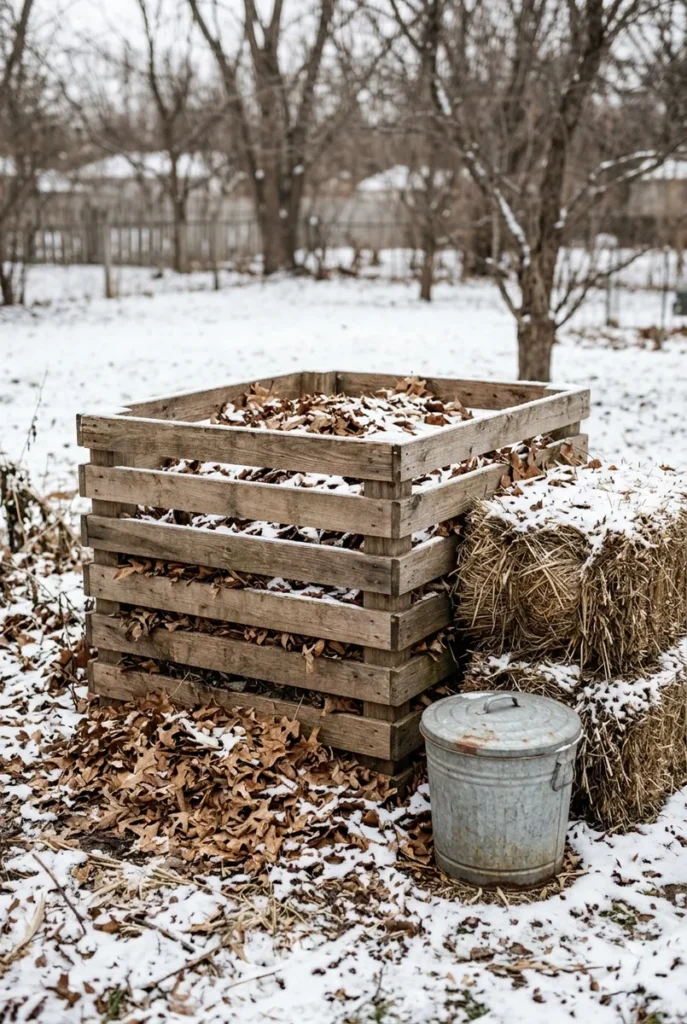
You can keep composting through winter, but decomposition slows in cold weather and stops only when the pile freezes completely, according to University of New Hampshire Extension. Keep an outdoor pile layered with browns and protected from excess rain and snowmelt, or store scraps in a covered container until you can add them.
Key Takeaways
- Cold weather slows composting, and a fully frozen pile starts working again when it thaws.
- Layer kitchen scraps with dry browns instead of letting winter additions become an all greens pile.
- A large pile may stay warm enough inside to keep working, while small piles are more prone to freezing.
Related guides
Choose a winter composting approach
You do not have to keep an outdoor pile actively working through every cold spell. Choose the method that fits your winter access, available space, and willingness to manage the pile.
| Winter option | Who it fits | Practical approach |
|---|---|---|
| Keep the outdoor pile going | You can reach the bin and add browns through winter. | Layer scraps with browns, protect the pile from excess rain and snowmelt, and avoid turning it until spring. University of New Hampshire Extension and University of Illinois Extension provide this winter pile guidance. |
| Pre compost bucket by the door | You can reach the bin now and then, but not every day. | Layer scraps with browns in a lidded bucket or bin and empty it into the outdoor pile when convenient (Cornell Cooperative Extension, NDSU Extension). |
| Indoor worm bin | You cannot get to the pile all winter, or you have no yard. | An indoor option the University of Illinois Extension suggests when outdoor composting is not practical. |
| Bokashi bucket | You want a sealed indoor container for kitchen scraps. | Also listed by the University of Illinois Extension as a winter alternative. |
| Food scrap drop off or pickup | You want no winter upkeep at all. | Check whether your town or a private service collects scraps (University of Illinois Extension). |
Prepare and insulate the outdoor compost bin
Stock up on brown materials in fall so you can keep layering them with scraps during winter. University of New Hampshire Extension recommends storing fall leaves under a tarp so they do not mat, and also lists straw, sawdust, wood chips, and shredded newspaper as browns.
| Brown material to stockpile | Winter storage or use | Source |
|---|---|---|
| Fall leaves | Store under a tarp so the leaves do not mat. Use them as browns with kitchen scraps. | University of New Hampshire Extension |
| Straw | Keep it dry for layering, or use it around the bin as insulation. | University of New Hampshire Extension |
| Sawdust or wood chips | Keep a covered supply near the door for layering. These materials can also line the inside of the bin. | University of New Hampshire Extension and NDSU Extension |
| Shredded newspaper | Store it dry and add it as a brown layer with kitchen scraps. | University of New Hampshire Extension |
Balance kitchen scraps with browns
For how to compost kitchen scraps in winter, keep the same basic habit with each addition: pair scraps with dry browns rather than letting greens build up on their own. University of New Hampshire Extension warns that an all greens winter pile can become a wet, smelly mess at spring thaw.
If you need a refresher on handling food scraps, use our step by step kitchen scrap composting guide. Cornell Cooperative Extension, Yates County also recommends chopping scraps and shredding leaves, which can be done with a lawn mower, to speed breakdown.
Manage cold, pile size, and the hot phase
Does compost freeze in winter? It can, but a frozen pile has not failed. University of New Hampshire Extension says decomposition slows in cold weather and stops only when the pile is completely frozen. A large pile can stay warm enough inside to keep working.
University of Illinois Extension explains why. The bacteria that run the hot phase of composting thrive between 113 and 167 degrees F. Below 68 degrees F, cold tolerant bacteria take over and work more slowly. The bigger the pile, the more heat it makes and holds, which is why small piles freeze first.
None of this means you need to keep turning a cold pile to chase heat. If your bin is small or you cannot tend it through winter, collect scraps separately and plan to combine them with the main pile in spring.
Turn less, and protect the pile from wet weather
There is no need to turn the outdoor pile in winter. University of New Hampshire Extension explains that turning releases heat, so leave the pile undisturbed until spring and turn it once it has thawed.
A compost tumbler holds a small amount of material, so it is more likely to freeze than a large pile. Expect it to slow down or stop until spring. If you want to compare bin styles, see our compost bin comparison guide, then choose a winter routine that suits your access and the amount of material you can keep together.
Rain and snowmelt can add unwanted moisture. Cover the pile to protect it from excess water while still letting air in, as University of Illinois Extension advises. If the material is too wet after thawing, Cornell Cooperative Extension, Yates County, recommends turning it and adding browns.
Store scraps safely when the pile is frozen
If you cannot reach the outdoor bin, use a covered pre compost bucket indoors or by the door. Cornell Cooperative Extension, Yates County, recommends layering scraps with browns in the container to help prevent smells, then emptying it into the outdoor bin when convenient.
NDSU Extension also recommends keeping dry browns in a covered container near the door and layering them with scraps in a lidded garbage bin, 5 gallon pail, or tote. This gives you a simple holding routine without adding an all greens layer to the outdoor pile.
Keep meat, fats, dairy, diseased plants, and pet feces out of the winter scrap container, following NDSU Extension’s guidance. If keeping a covered container is not practical, University of Illinois Extension lists an indoor worm bin, bokashi bucket, and food scrap drop off or pickup service as alternatives.
Restart the pile after thaw
- Check the pile after it thaws. If it is too wet, turn it and add browns, following Cornell Cooperative Extension, Yates County.
- Mix winter material into the main pile. NDSU Extension recommends mixing the winter material into the main pile in spring.
- Turn once it has thawed. University of New Hampshire Extension recommends waiting until spring and turning the pile once thawed.
- Keep layering if you continue adding scraps. University of New Hampshire Extension advises keeping greens layered with browns to avoid a wet, smelly pile at spring thaw.
Once you have finished compost, it can be one ingredient you measure with our potting mix calculator. For a separate guide to the role of compost in garden soil, read our compost and fertilizer comparison.
Winter Composting Checklist
- Stockpile fall leaves under a tarp so they do not mat.
- Keep dry browns in a covered container near the door.
- Layer scraps with browns in the outdoor pile or a covered holding container.
- Leave out meat, fats, dairy, diseased plants, and pet feces.
- Cover the outdoor pile against excess rain and snowmelt while allowing air in.
- Insulate the bin with bags of leaves or straw bales, or line its inside with suitable browns.
- Skip winter turning, then turn the pile in spring once it has thawed.
- If the thawed pile is too wet, turn it and add browns.
Summary
In winter you have two choices: maintain a layered, covered outdoor pile, or collect scraps until you can add them in spring. Keep browns close, avoid unnecessary winter turning, and remember that a frozen pile can resume when it thaws.
Frequently Asked Questions
Does compost freeze in winter?
Yes. University of New Hampshire Extension says decomposition slows in cold weather and stops only when a pile is completely frozen. A frozen pile can resume when it thaws.
Should I turn my compost pile in winter?
No. University of New Hampshire Extension says turning in winter releases heat from the middle of the pile. Wait until spring, once the pile has thawed.
What should I do if my compost is too wet after winter?
Once the pile has thawed, turn it and add browns. Cornell Cooperative Extension, Yates County, recommends this response to a pile that is too wet after thaw.
Can I add kitchen scraps if the outdoor pile is frozen?
If you cannot reach the pile, hold scraps in a covered container layered with browns, then empty it into the outdoor bin when convenient. Cornell Cooperative Extension, Yates County, recommends this pre compost bucket approach.
Can I leave the compost pile uncovered when snow is expected?
Cover the pile to protect it from excess rain and snowmelt while still allowing air in. University of Illinois Extension recommends this approach for winter composting.